
What Our Security Logs Revealed About a Product Problem
It Started With Slack Alerts
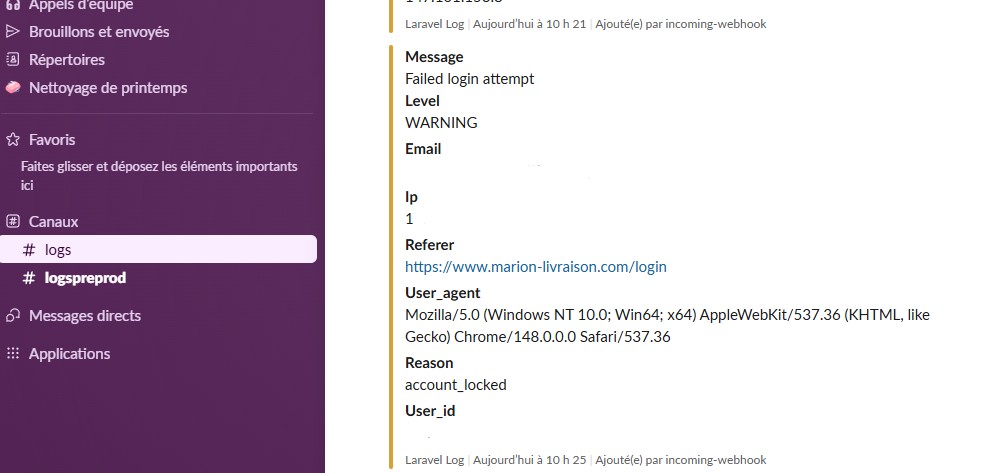
For several months, we kept receiving alerts automatically raised from our logs:
- too many login attempts;
- temporarily locked accounts;
- password resets.
Taken individually, these events seemed anecdotal.
But their frequency eventually caught my attention.
The Context: A Deliberate Product Choice
At Marion Livraison, we made the choice of having a single account per company.
This choice simplifies:
- onboarding;
- billing;
- administration.
Several employees therefore use the same credentials.
It was a deliberate trade-off.
The Problem Wasn't the Login
By analyzing the alerts, we uncovered a recurring scenario.
An employee forgets the password.
They reset it.
The other employees keep using the old password.
The attempts fail.
The system triggers the brute-force protection mechanism.
The account gets temporarily locked.
The problem wasn't authentication.
The problem was managing a shared secret.
The Perfect Solution Was Disproportionate
We could have built:
- individual accounts;
- roles;
- access administration.
But that would have added significant complexity for a problem that was, in the end, well understood.
So we chose a more pragmatic solution.
Reducing the Frequency of Friction
We added an option:
Remember me for 30 days on this device.
Available for monthly-billed business accounts.
The goal wasn't to eliminate the problem entirely.
The goal was to reduce the number of situations where users had to re-enter a shared password.
Fewer logins.
Fewer resets.
Fewer locked accounts.
What I Take Away From This
Not every product problem is found in user interviews.
Some show up in logs.
Others in support tickets.
Others still in technical alerts.
The role of a Product Manager often consists of connecting these weak signals to understand what they actually reveal.
In our case, repeated security alerts were hiding a friction point tied to a deliberate product choice.
The right answer wasn't to question that choice.
It was to reduce its side effects.