
Why I Chose This North Star Metric for Marion Livraison
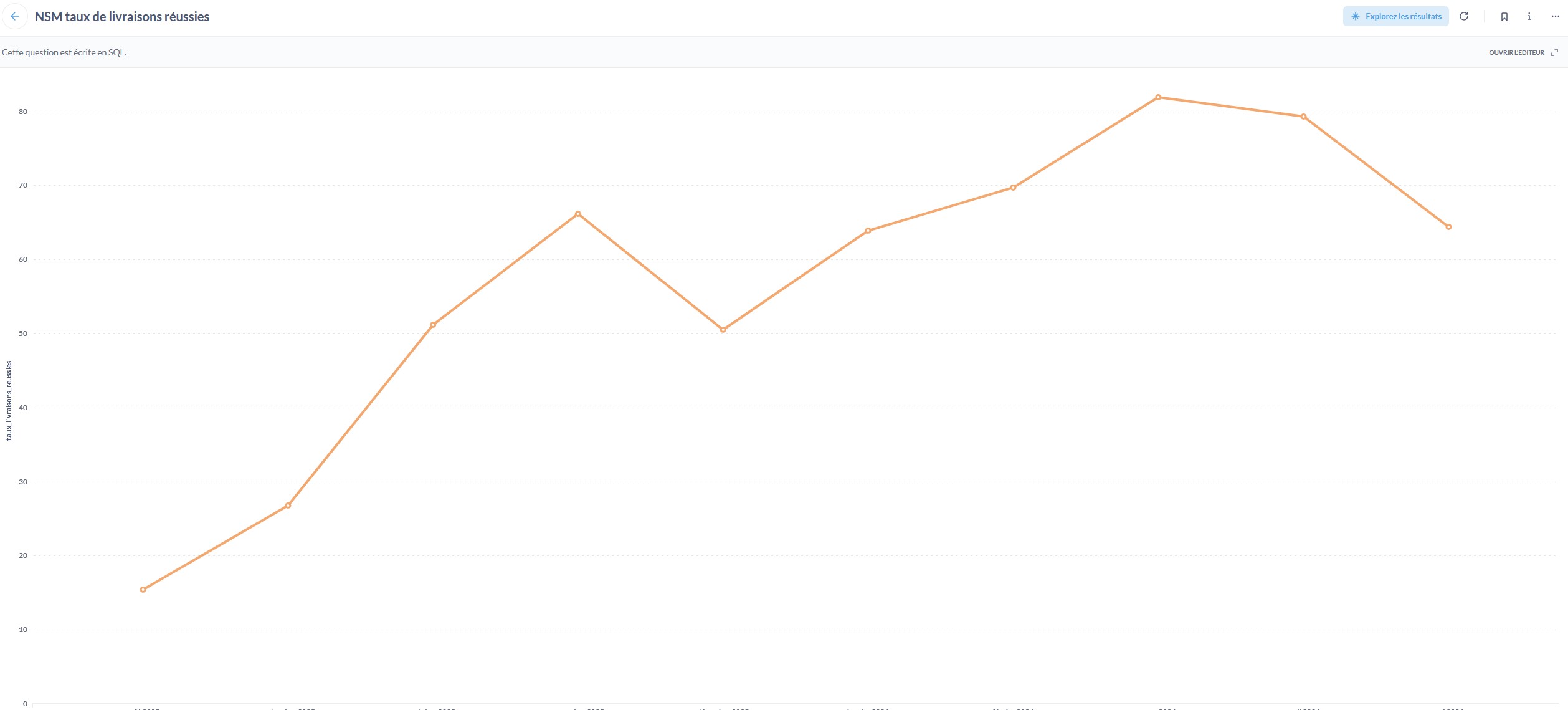
When people talk about North Star Metrics (NSM), the same examples keep coming up:
- Spotify → listening time
- Airbnb → nights booked
- Uber → completed rides
- Slack → active teams
But in a construction delivery business, the product reality is different.
At Marion Livraison, the question wasn't:
"How do we increase engagement?"
The real question was:
"How do we guarantee a delivery experience reliable enough to generate repeat business and trust?"
That's what led me to choose our North Star Metric.
The chosen NSM
Marion Livraison's current NSM is:
The rate of deliveries completed within the promised window.
Concretely, a delivery is considered successful when it is completed within the timeframe promised to the customer.
For example:
- delivery scheduled for 10am,
- delivery completed before 10:30am,
- the delivery is considered "within the promise."
This metric may seem simple, but it actually concentrates a large part of the product's value.
Why this metric genuinely represents the value created
In construction, a late delivery isn't just a "bad UX moment."
It can trigger:
- a blocked worksite,
- an idle crew,
- an immobilized tradesperson,
- additional costs,
- a loss of trust toward the supplier.
In other words, the product's value isn't just about "delivering."
The value is:
- delivering to the right place,
- at the right time,
- with enough reliability to become predictable.
That's exactly what this NSM measures.
Why I didn't choose other metrics
1. Number of deliveries
This is an important business metric, but it's not a good NSM.
Why? Because you can increase volume while significantly degrading the experience: delays, cancellations, errors, operational overload.
This metric measures growth. Not delivered value.
2. Revenue
Same problem. Revenue is a consequence, not the core of product value.
A good NSM must represent user experience, value created, and be correlated with long-term growth.
3. Average delivery time
This metric is interesting but incomplete. A low average time doesn't necessarily mean the customer promise is being kept.
4. Number of active customers
The problem is that it often reacts with a lag. When the number of active customers drops, it generally means problems have already existed for a while: delays, poor experience, lack of reliability, repeated frustrations.
I wanted a metric closer to the real experience lived by the customer — one capable of alerting earlier and being actionable day-to-day by both product and operations teams.
The on-time delivery rate within the promise window makes it possible to identify problems before they durably impact retention.
What this NSM changes in product decisions
An NSM doesn't just serve for reporting. It clearly influences product priorities.
Since implementing this metric, several topics have become priorities:
- improving journey time estimates,
- optimizing driver assignment,
- better real-time visibility,
- delay management,
- address data quality (pickup points and worksite information).
The NSM acts as a decision filter. When a feature is proposed, the question becomes:
"Does this improve our ability to keep the delivery promise?"
What I learned working on this NSM
An effective North Star Metric must be:
1. Understandable by the whole company — Operations, support, product, leadership: everyone must immediately understand what it represents.
2. Correlated with user value — If the metric goes up but the real experience doesn't improve, it's not a good NSM.
3. Actionable — Teams must be able to act on it concretely.
4. Hard to "fake" — Some metrics can be artificially improved without creating real value. Here, keeping a delivery promise requires genuine operational excellence.
In hindsight, is this the perfect NSM?
Probably not, since an NSM can also evolve with product maturity.
In time, Marion Livraison may shift toward a metric more oriented around retention, order frequency, or repeat purchase rate.
But today, in a phase where operational trust is critical, this metric best represents the value created by the product.
Conclusion
Choosing a North Star Metric isn't a theoretical exercise. It's a strategic decision with a direct impact on product decisions: prioritization, effort, trade-offs.
In the case of Marion Livraison, the promise is simple: enabling professionals to receive their materials reliably and predictably.